
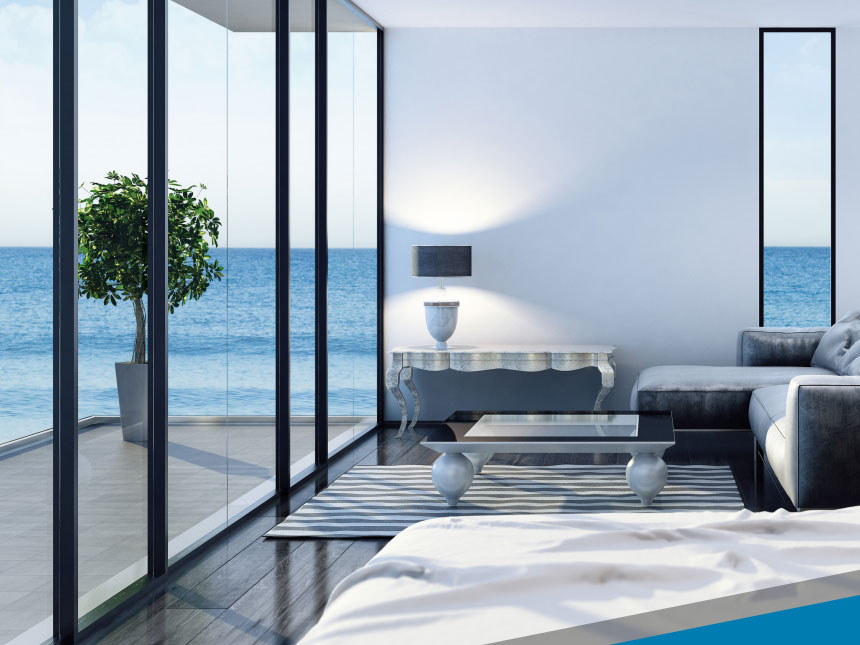
On a waterfront lot, the glass you paid the most for is also the glass everyone else can see into. A canal in Coral Gables, a finger channel off the Fort Lauderdale Isles, the main Intracoastal run through Hollywood and Delray, they all put your living room, kitchen, and primary suite directly in the sightline of passing boats and the neighbors sitting on the dock across the water. That is the problem I get called about most on water-facing homes, and it is a different problem than heat. This post is about privacy and exposure on Intracoastal and canal-front glass specifically: keeping boaters and across-the-water neighbors from looking straight in, what happens to that privacy after dark, and why large unprotected water-facing spans and marine salt exposure change how film gets specced.
Who is actually looking in, and from where
Inland, your privacy threat is a neighbor at a fixed angle you can screen with a hedge. On the water it is nothing like that. The waterway is a public right of way, so anyone on it has a legal line of sight to your glass. On a busy Intracoastal stretch that means a steady parade of center consoles, sportfishers, paddleboards, and tour boats through the middle of the day, every one of them elevated a few feet above your ground floor and looking slightly down into the room.
Then there is the neighbor directly across a narrow canal, often close enough to read a book on your coffee table, and their dock guests, who sit at the water's edge with nothing between them and your sliders. Curtains would solve it and destroy the entire reason the house faces the water. That is the corner waterfront owners get stuck in, and where daytime privacy film earns its place.
How daytime privacy film keeps the view you paid for
The fix for the boat-and-neighbor sightline is a film that reads very differently from each side in daylight. A privacy tint or reflective film reflects a portion of exterior light back off the outer surface, so from the water the glass looks like a dark or mirrored panel and the room behind it drops out of view. From inside, where the light level is lower, you keep looking straight through to the water. The dock, the channel, the sunset over the Intracoastal all stay exactly as sharp as before.
On boat-facing elevations I usually reach for a more reflective film, because the viewing distance across open water is longer and a stronger exterior reflection reads cleaner from a moving boat. On a tight canal where the neighbor is close and a mirror finish would feel harsh across a narrow gap, a neutral ceramic privacy film gives softer screening without the bright reflective look. It is common to run both on one house: reflective on the wide water side, ceramic privacy on the close canal side.
Visible light transmission on these films runs roughly 15 to 50 percent depending on how much screening you want, and because the same film rejects solar load, an SHGC down near 0.21 comes along with the privacy on those hot west-facing water elevations. If heat is a bigger concern than sightlines on part of the house, our heat rejection guide covers that side in more depth.
The honest part: what happens after dark
Any installer who tells you film gives you privacy at night is selling you something. The daytime effect works because outside is brighter than inside. After sunset that flips. Once your interior lights are on and the water outside is dark, the glass behaves like a lit stage, and a boater or neighbor across the canal sees in more clearly than they ever did at noon. Reflective film does not change that physics.
So on a waterfront home I treat night privacy as a separate line item, not something the film covers. The move is to identify the small number of panes where evening privacy actually matters, typically the primary suite and one or two rooms you use with the lights on after dark, and pair the film there with a blind, a shade, or a treatment you close at night. Everywhere else, the daytime film does the heavy lifting during the hours boats are actually running, and the room stays open to the view the rest of the time. Setting that expectation up front is the difference between a happy waterfront client and a callback.
Storm and debris exposure on big water-facing spans
Waterfront elevations tend to carry the largest, most continuous glass on the house, corner sliders and floor-to-ceiling walls facing straight down an open fetch of water. That open fetch is also the direction windborne debris travels in a storm, with no neighboring structure to break it up. A lot of these homes, especially older Coconut Grove and Coral Gables properties and second-story panes on newer builds, still run non-impact glass on the water side.
For those spans, anti-shattering security film at 8 mil bonds to the interior face and holds broken fragments in the opening instead of letting a shattered slider spray into the room. No film is hurricane-proof, and Florida law does not let anyone market it that way, and film is not a substitute for impact glazing under the building code. What an 8-mil film with an engineered frame anchor gives you is fragment retention and breach delay on that big unprotected water-facing wall, documented under a Miami-Dade Notice of Acceptance for the assembly, which is the paperwork inspectors and insurers want to see.
Marine adhesive and why the water side is specced differently
Salt does not care that the film is on the inside of the glass. On a home sitting a few feet off the water, salt-laden air, humidity, and the sheer intensity of light coming off the surface put more stress on an installation than an inland job ever sees. That is why I do not spec a water-facing elevation the same way I would a street-facing one.
For interior residential film the salt lives on the outer face of the glass and the standard adhesive system carries the usual warranty, commonly around 15 years on solar and security film. Where it changes is anything closer to true marine service, the most exposed splash-facing panels and any boat or yacht glass, which get salt-rated marine adhesives and run a shorter warranty in the four-to-eight-year range because of the constant exposure. Getting that call right at the quote stage is what keeps a waterfront install from lifting or hazing at the edges a few seasons in.
Frequently asked questions
Will privacy film stop boaters on the Intracoastal from seeing into my house?
During daylight, yes. A reflective or ceramic privacy film makes the water-facing glass read as a dark or mirrored panel from a passing boat while you keep looking out. The effect is strongest in daytime, which is when boat traffic is heaviest.
Does the film still give me privacy from the neighbor across the canal at night?
Not on its own. After dark with your lights on, the glass reverses and anyone across the water can see in more easily. For the specific rooms you use lit at night, pair the film with a blind or shade you close in the evening. The film handles the daytime, when the dock and channel traffic is actually out there.
Can I get privacy without blocking my water view?
Yes, that is the whole point of a one-way daytime film. It screens the room from the outside while leaving your view of the water sharp from inside. You are not trading the view for the privacy, you are getting both during the day.
Is film enough to protect my big water-facing sliders in a storm?
Film adds fragment retention and breach delay on non-impact glass, and with a frame anchor it can carry a Miami-Dade Notice of Acceptance, but it is not a legal substitute for impact glazing. On large unprotected spans facing open water it is a meaningful upgrade, and we will tell you honestly where impact glass is the better call.
If you own an Intracoastal, canal-front, or oceanfront home in South Florida and want daytime privacy from boats and neighbors without giving up the view, contact Blackridge Film for a free consultation. You can also browse window film across South Florida and the waterfront areas we cover, from Fort Lauderdale and the Isles to Coral Gables, Coconut Grove, Hollywood, Boca Raton, and West Palm Beach.